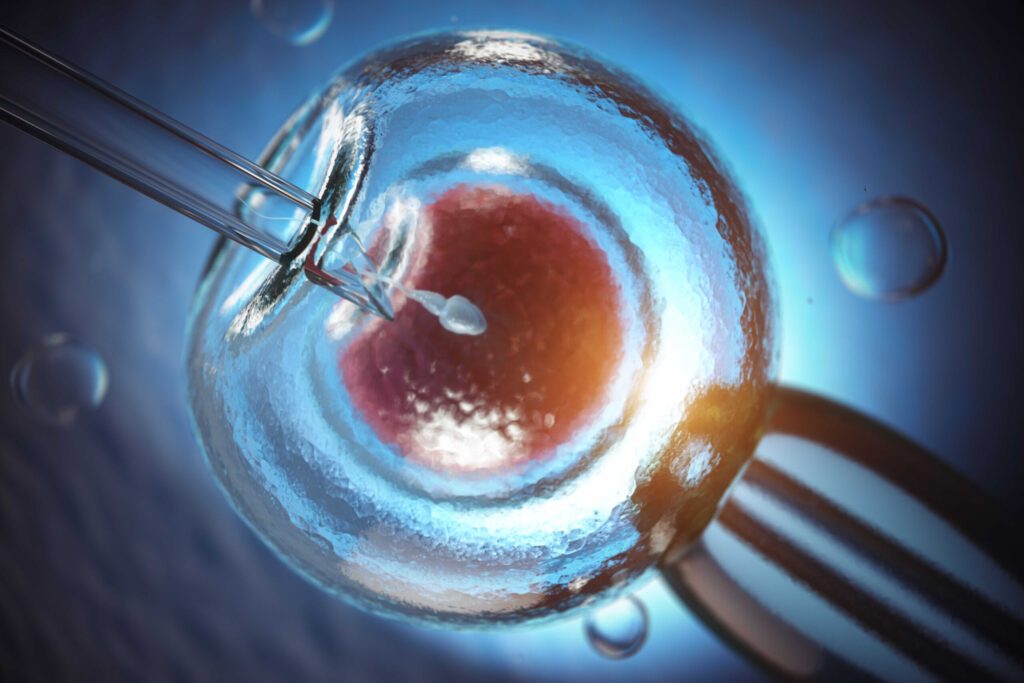
Intracytoplasmic Sperm Injection (ICSI) is the process of taking a single sperm and injecting it directly into an egg. This egg is then transferred into the womb through IVF treatment.
Who is ICSI suitable for?
ICSI may be recommended for a number of reasons as an alternative to conventional IVF. These include male infertility, unsuccessful IVF treatment and if you are using frozen eggs.
Male infertility
Most male infertility is linked to sperm quality and health. An intracytoplasmic sperm injection (ICSI) is often recommended by fertility specialists if you are struggling with sperm-related problems, such as poor motility (poor movement), poor morphology (abnormally shaped), and low sperm count.
If you have sperm with poor motility and poor morphology, ICSI can be beneficial because the sperm can struggle to reach the egg naturally or in laboratory conditions. Using ICSI, the sperm is injected directly into the egg, mitigating the need for the sperm to reach the egg independently.
Low sperm count and vasectomy
ICSI is used in instances where there is a low sperm count, or there are high levels of antibodies in the semen, which also affects the sperm count. A low sperm count can mean that conventional IVF is not successful.
If you have had a vasectomy and the sperm has been collected through an epididymis or directly from the testicles, then ICSI is often used.
Erection and ejaculation
If the male partner struggles with maintaining erections, ICSI treatment can be used by collecting the sperm directly from the testicles through an epididymis. This could be due to health, injury and other disorders, such as retrograde ejaculation or a blockage in the reproductive tract.
Egg freezing
The use of more mature, previously frozen eggs or if eggs being used are from someone over the age of 35, then ICSI might be recommended by your fertility specialist.
Unsuccessful IVF treatment
If you have been attempting to get pregnant by conventional IVF treatments, yet they have been unsuccessful, ICSI might give you a better chance of getting a successfully fertilised egg.
Understand more about ICSI and when it should be used: Watch Now
What is the ICSI procedure?
Below is an overview of what you can expect from the ICSI procedure. Parts of the procedure may alter depending on whether you are using donor sperm and eggs and frozen eggs. You can discuss this further with your fertility specialists.
1- Ovarian stimulation
The female partner will take fertility drugs to stimulate the ovaries to produce multiple mature eggs.
2- Egg collection
These eggs are retrieved by a thin needle through the wall of the ovaries. This will take place under anaesthetic to reduce pain.
3- Sperm sample
A sperm specimen is taken on the same day as the egg retrieval or frozen sperm can be used. The male providing the sperm must not have sex or masturbate three days prior to the collection of the sperm sample.
Surgical sperm retrieval may be used for males who have difficulty with ejaculations or...