Put very simply, IUI and IVF are both Assisted Reproductive Techniques (ART) offered to couples or individuals who are struggling to conceive naturally through sexual intercourse.
They are also commonly used procedures for members of the LGBT+ community and heterosexual individuals without a partner. IUI is a less invasive and less complex procedure than IVF, so it’s often offered first as an option, depending on the results of initial fertility tests.
What is IUI?
IUI (intrauterine insemination) is a fertility treatment in which sperm is inserted directly into a woman’s womb via a thin tube. If the woman has no other identified barriers to conception, then it’s a simpler way than IVF to put the sperm and the egg together.
The sperm can come from the woman’s own male partner or donor sperm can be used. If a couple are using their own sperm, the man will need to provide a sperm sample on the day of the IUI procedure, which will then be washed in the lab and the healthiest sperm selected. With donor sperm, it needs to be frozen in advance, to allow time for the detection of any infections or inherited diseases.
It's possible to have either a stimulated cycle (with fertility drugs) or an unstimulated cycle (without fertility drugs). The medical history of the couple or the individual and the success rates of both IUI options can be discussed with the fertility specialist.
IUI is generally a low-risk procedure, taking about 10 minutes and with few side-effects.
What is IVF?
IVF (in-vitro fertilisation) is often referred to as ‘a journey’ or ‘a process’ as it involves multiple hospital visits, medication and a lot of waiting periods.
The process usually starts with fertility drugs, administered at home via self-injection, to stimulate the ovaries to release more eggs than usual. Scans and possibly blood tests will be used to detect how the follicles are responding to the medication and to pinpoint the best time to collect the eggs.
The eggs are collected under sedation, using a fine needle passed through the vaginal wall.
As with IUI, a sperm sample will need to be given on the day of the egg collection, or, if using donor sperm, the sample will need to have been frozen.
More medication may be required to prepare the lining of the uterus ready for embryo transfer, if viable embryos are produced.
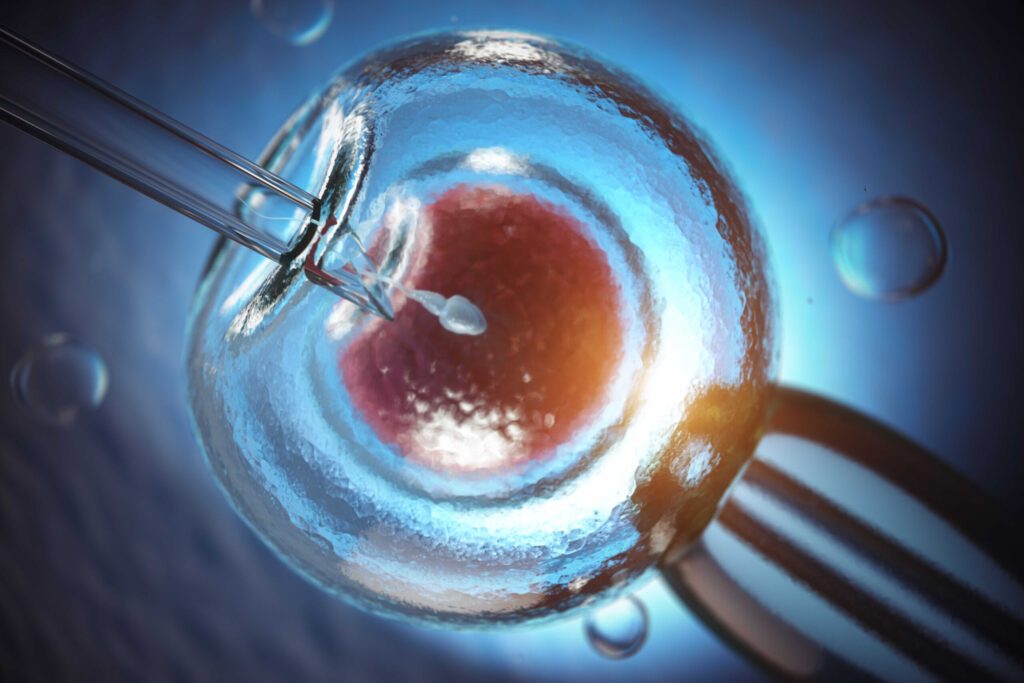
The healthiest sperm are selected from the sample and added to the eggs in a special dish in the lab. If the ICSI procedure is being used, the sperm will be injected directly into each egg. After this, the dishes are placed into an incubator to allow fertilisation to take place.
If viable embryos are produced, then a few days later, a catheter will be used to transfer one or two embryos into the woman’s uterus.
How do we choose between IUI and IVF?
IUI is not suitable for all couples or individuals who are trying to conceive, for example, if...